From melting ice to mobile cold chain muscle, the refrigerated truck’s wild rise proves one breakdown can turn profits into puddles.
The refrigerated truck didn’t just show up with a hum and a cooling unit—it crashed the party and saved dinner. From coast-to-coast strawberries to life-saving vaccines, this rolling icebox keeps your cargo from turning into a costly mess. When your load is on the line, “almost cold” doesn’t cut it.
One breakdown, one hot afternoon, and profits melt fast.
So how did we get from blocks of melting ice to high-tech cold chain muscle on wheels? Buckle up—the origin story is packed with grit, guts, and a dash of genius.
Ice-Wagon Precursors
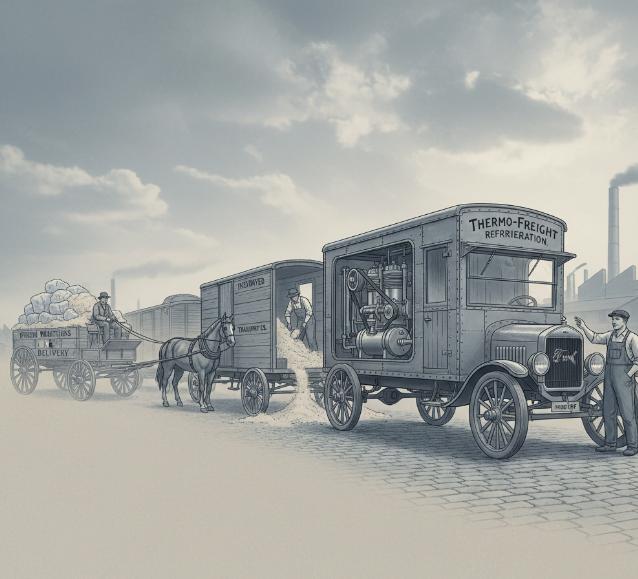
The earliest refrigerated truck roots came from horse-drawn ice wagons using blocks of ice, wooden bodies, and insulation materials like sawdust and cork.
Mechanical Refrigeration
Engine-driven compressors, condensers, evaporator coils, and chassis integration turned cooling from ice-based storage into dependable mobile refrigeration.
Smart Cold Chain Era
Modern fleets use hybrid systems, telematics, GPS tracking, sensors, and cloud dashboards to manage temperature control and compliance in real time.
Who Invented The Refrigerated Truck?
Cold food didn’t just magically start rolling across states. The refrigerated truck changed how meat, dairy, and produce reached dinner tables. Before today’s advanced refrigeration truck systems, there were ice boxes on wheels and a lot of trial and error.
Ice-Wagon Precursors and Insulated Panels
The roots of the refrigerated truck go back to the ice wagon era, when horse-drawn vehicles carried perishables through rough city streets.
Early cooling relied on:
Blocks of ice stored in overhead bunkers
Wooden bodies fitted with insulated panels
Sawdust packed tightly for temperature control
As early transportation evolved, builders improved food preservation methods through layered insulation:
Natural insulation phase
Sawdust
Cork lining
Transitional insulation phase
Thicker wood walls
Sealed joints to reduce air leaks
Modern insulation shift
Early rigid foam
Later polyurethane panels
Foam cores
These upgrades laid the groundwork for every modern refrigerated truck on the road. Without better insulation, a cold truck was just a wagon with melting ice.
Gustavus Swift’s Refrigeration Unit Assembly
The big leap came with Gustavus Swift, a name tied closely to meat packing and refrigerated transport.
His approach connected several ideas:
Refrigeration unit design
Coordinated assembly line production
Use of modified railroad cars for long-distance meat packing
Within Swift’s system:
Cooling design
Ice chambers placed strategically
Air circulation channels guiding cold air
Distribution shift
Centralized slaughter
Rail shipment to urban markets
Cold chain thinking
Controlled loading
Sealed doors
Scheduled delivery
The International Institute of Refrigeration noted in its 2024 industry outlook that “modern cold chain systems are built upon 19th-century mechanical refrigeration breakthroughs that reshaped global meat distribution.”
That innovative design mindset directly influenced later refrigerated truck engineering. Companies like Reefertruckpro still echo that practical thinking—tight assembly, clean airflow, no shortcuts.
Early Compressor Integration on Truck Chassis
Mechanical refrigeration pushed the refrigerated truck into a new league.
Instead of ice, engineers introduced compressor technology powered by engine power. The shift happened step by step inside the evolving truck chassis:
Mechanical foundation
Mounting brackets welded to frame
Reinforced chassis rails
Cooling system integration
Engine-driven compressor
Roof-mounted condenser
Internal evaporator coils
Mobility refinement
Vibration control
Fuel efficiency balance
Quality testing before delivery
This move from ice to mechanical refrigeration created true mobile cooling. The refrigerated truck became reliable in summer heat, not just winter weather.
Today’s reefer truck and cold truck designs still follow that blueprint. Brands like Reefertruckpro refine compressor placement, airflow channels, and insulation so every refrigerated truck performs like a serious piece of transport evolution—not just a box with a fan.
3 Key Innovations That Shaped Refrigerated Trucks
High-Efficiency Compressor and Condenser Unit
Improves the refrigeration cycle, supports better heat exchange, increases cooling capacity, and reduces energy use in real-world fleet operations.
Polyurethane Foam Insulated Panel Application
Reduces heat gain, supports structural integrity, and helps a refrigerated truck maintain stable temperature control across the cargo zone.
Real-Time Temperature Monitoring with Sensors
Enables data logging, remote monitoring, alerts, and daily operational accountability to protect cold chain integrity.
High-Efficiency Compressor and Condenser Unit
At the core of any refrigerated truck sits the cooling engine: the compressor and condenser working through a closed refrigeration cycle.
Core Mechanical Loop
Handles heat exchange with outside air.
Converts vapor to liquid for cycle stability.
Increases refrigerant pressure.
Directly impacts cooling capacity.
Compressor
Condenser
Energy Performance
Reduces strain on the refrigeration truck engine.
Improve energy efficiency under partial loads.
Variable-speed drives
Optimized airflow design
Practical Impact on a Reefer Truck
Faster pull-down time.
Lower diesel or electric consumption.
Stable cargo temperature in a cooling truck during long hauls.
| Component Type | Avg. Energy Efficiency (%) | Cooling Capacity (kW) | Emission Reduction (%) |
|---|---|---|---|
| Fixed-Speed Unit | 78 | 18 | 5 |
| Variable-Speed Unit | 88 | 20 | 15 |
| Electric Standby | 92 | 17 | 22 |
| Hybrid Drive | 90 | 19 | 18 |
Better heat exchange and tighter control mean fewer temperature swings inside the refrigerated truck body.
Polyurethane Foam Insulated Panel Application
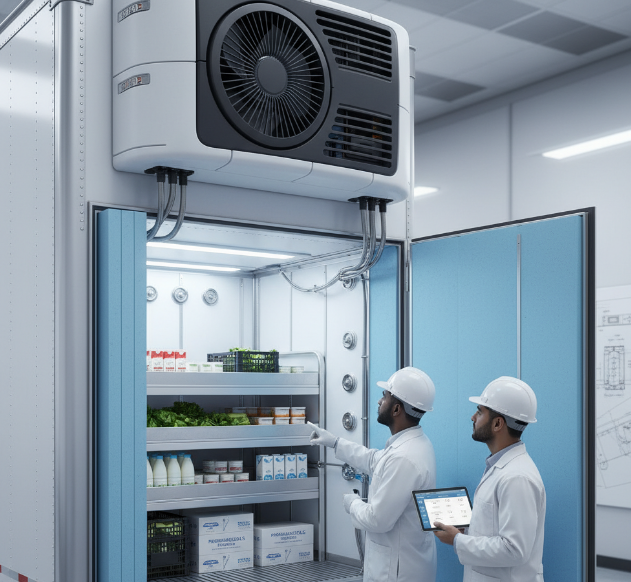
A refrigerated truck is only as good as its insulation. That’s where polyurethane foam steps in.
Panel Construction Layers
Food-grade surface for hygiene.
High-density polyurethane foam.
Low thermal conductivity.
Fiberglass reinforced plastic or aluminum alloy.
Outer Skin
Core Layer
Inner Lining
Thermal Control Performance
Reduced heat gain during door openings.
Consistent temperature control across the cargo zone.
Structural Integrity
Strong panel construction boosts structural integrity.
Lighter body increases payload for a refrigerated truck.
Thicker foam, tighter lamination, fewer gaps. That’s how a modern cold truck keeps vaccines, dairy, or seafood right where they need to be.
Real-Time Temperature Monitoring with Sensors
Keeping a refrigerated truck cold isn’t guesswork anymore.
Temperature sensors placed at multiple cargo points.
Continuous data logging stored locally and in the cloud.
Remote monitoring through fleet dashboards.
Here’s how it flows in daily operation:
Sensors capture readings every few seconds.
Data passes to onboard controllers.
Alerts trigger if limits are crossed.
Managers review reports to protect cold chain integrity.
Add calibrated alarm systems, routine calibration, and synced telematics, and a refrigeration truck becomes a rolling data hub. Short trip or cross-country haul, the refrigerated truck stays accountable. And that’s what keeps food safe and pharma compliant, no drama on delivery day.
Generations Of Refrigerated Truck Technology
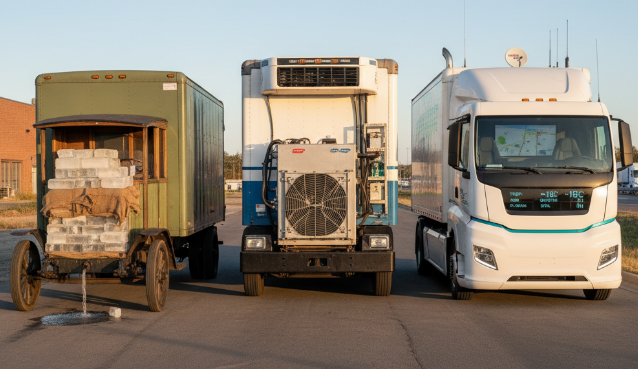
Cold chain history is basically the story of the refrigerated truck growing up. From ice-packed cargo beds to GPS-driven truck refrigeration units, every jump changed how food moves across cities and highways.
First Gen Ice-Based Cooling Systems
Early refrigerated truck models were simple, almost rough around the edges, yet surprisingly clever.
Cooling Core System
Ice blocks were stacked above cargo.
Salt was added to lower melting temperature.
Meltwater drained through floor channels.
Cargo Protection Design
Thick Insulation panels lined wooden walls.
Roof Ventilation openings controlled airflow.
Basic sealing reduced warm air intrusion.
Vehicle Platform
Modified Early Trucks carried insulated boxes.
No engine-driven cooling existed.
Trips were short due to melting limits.
Outcome for Cargo Preservation
Meat and dairy survived local transport.
Long-haul refrigerated transport was risky.
Temperature swings were common.
This ice-based truck refrigeration method laid the groundwork for every reefer truck that followed. It was messy but it worked—kind of.
Mechanical Refrigeration and Chassis Integration
Compressor units powered by Engine Power
Heat release through Condenser coils
Cooling delivery via Evaporator systems
Full Chassis mounting integration
Closed-loop Refrigerant circulation for steady Temperature Control
Here’s how performance improved over time:
| Generation | Cooling Method | Avg Temp Range (°C) | Fuel Use (L/100km) | Load Capacity (Tons) |
|---|---|---|---|---|
| Ice-Based | Ice + Salt | 0 to 10 | 0 | 3–5 |
| Early Mechanical | Belt-Driven Compressor | -5 to 5 | 4–6 | 6–10 |
| Integrated Chassis Units | Engine PTO Driven | -18 to 4 | 6–8 | 10–18 |
| Advanced Reefer Truck | Dedicated Diesel Unit | -25 to 5 | 5–7 | 18–26 |
With integrated truck refrigeration, cold chain shipping finally became reliable. Brands like Reefertruckpro design systems where compressor placement and chassis balance work together, keeping a refrigerated vehicle stable on long hauls.
Short runs got easier. Cross-country routes became normal. The refrigerated truck stopped being local and went national.
Hybrid Refrigeration with Telematics and GPS Tracking
Modern refrigerated truck fleets mix cooling power with data control.
Hybrid Cooling Architecture
Diesel + electric Hybrid Systems
Shore power standby for urban delivery
Fuel-saving efficiency modes
Smart Visibility Layer
Telematics units collect performance data
GPS Tracking supports route accuracy
Real-time Remote Monitoring via cloud dashboards
Continuous Data Logging for compliance
Fleet Optimization
Predictive maintenance alerts
Multi-zone temperature mapping
Centralized Fleet Management controls
A temperature-controlled truck today talks back. Operators check cargo status from a phone while the truck refrigeration system auto-adjusts airflow.
That’s where companies like Reefertruckpro stand out—combining hardware efficiency with smart tracking so every refrigerated vehicle runs tighter, cooler, and smarter.
Technology Progression
Ice-based cooling with salt and drainage channels
Mechanical refrigeration with compressors and condensers
Integrated chassis units for steady long-haul performance
Hybrid refrigeration with telematics and GPS tracking
From ice wagon to high-performance refrigerated trucks, the journey was gritty, practical, and driven by real-world need.
The refrigerated truck isn’t just cold anymore. It’s connected.
FAQ
How do modern refrigerated truck systems keep cargo at precise temperatures?
A modern refrigerated truck works like a mobile cold room designed to protect cargo throughout transport. Precise temperature control depends on three connected layers working together.
Core cooling hardware: The refrigeration unit uses a compressor, condenser unit, and evaporator coil to circulate refrigerant and remove heat. Insulated panel walls help reduce heat transfer and maintain stable insulation thickness.
Smart control network: A temperature sensor and thermostat regulate cooling output in real time. A data logger records temperature changes for food safety compliance, while telematics and GPS tracking can send live alerts during pharmaceutical logistics or food distribution.
Operational protection: Many systems support multi-temperature zone control for temperature-controlled shipping and help preserve cold chain integrity from warehouse loading to last-mile delivery.
Behind every on-screen temperature reading is a driver and fleet manager relying on stable temperature monitoring to protect perishable goods transport.
What materials and manufacturing processes shape a high-quality refrigerated truck body?
A high-quality refrigerated truck body is built through careful material selection, layered insulation design, and strict manufacturing control.
Wall and roof panels: Fiberglass reinforced plastic combined with polyurethane foam is commonly used to improve insulation thickness and support energy efficiency optimization. These parts are usually formed through panel lamination and insulation application.
Frame and edges: Aluminum alloy and stainless steel are often selected for strength, corrosion resistance, and durability. Welding and chassis integration help support payload capacity and long-term structural stability.
Sealing zones: Sealants and adhesives are applied during refrigeration system assembly to prevent air leakage and protect cold chain management performance.
After assembly, the truck body usually goes through quality control testing to verify structural strength, temperature stability, and compliance with ISO standards and ATP certification requirements.
Every layer matters, because even a small thermal leak can put an entire shipment of fresh food or medicine at risk.
How is compressor technology evolving in refrigerated truck design?
Compressor technology is playing a bigger role in making refrigerated trucks more efficient, reliable, and practical for daily transport work.
Energy efficiency: Modern compressor systems are designed to reduce fuel consumption and help operators meet stricter emission standards under transport refrigeration guidelines.
Hybrid refrigeration integration: Electric standby modes can reduce engine idling during loading, unloading, or urban food distribution, which improves operating efficiency and lowers noise.
System coordination: Better interaction between the compressor, condenser unit, and evaporator coil improves refrigeration system assembly reliability and helps maintain stable cargo temperatures.
Vehicle design support: Aerodynamic design, optimized rear door configuration, and practical side door access can reduce energy loss during frequent stops and improve temperature-controlled shipping performance.
The overall result is stronger cold chain integrity, steadier temperature control, and quieter operation that drivers and fleet operators value during long-haul and urban delivery work.