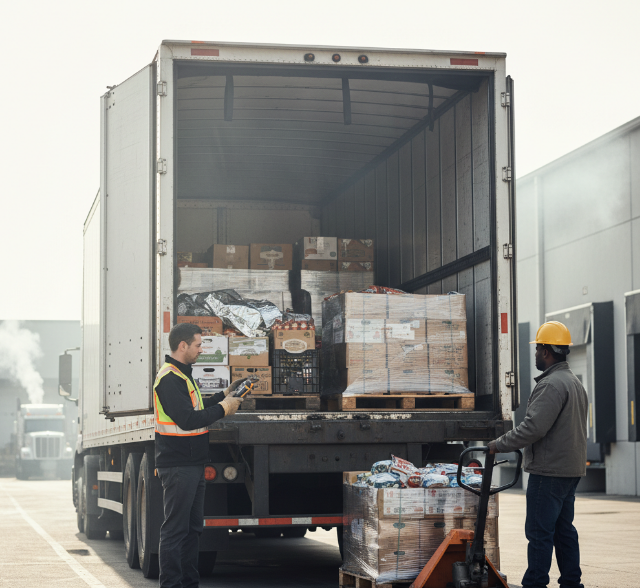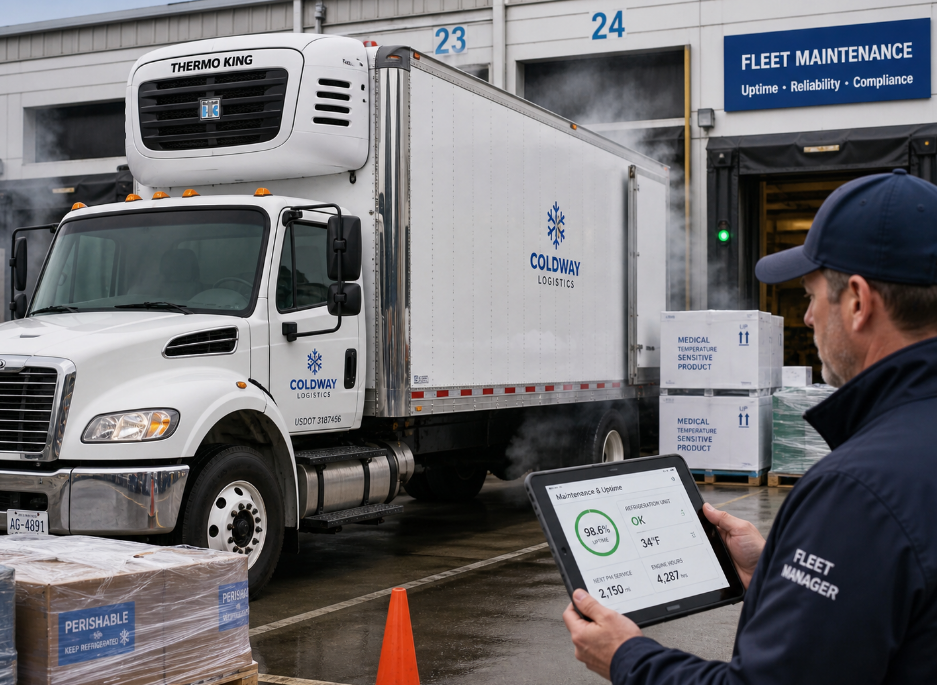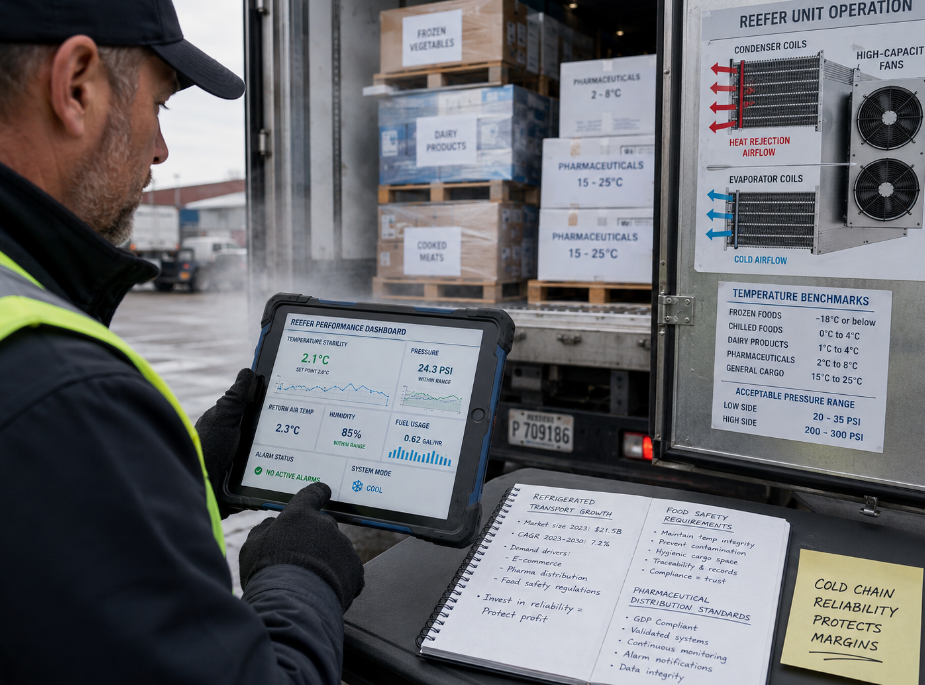
When profits hang by a cold thread, your reefer truck keeps them alive—meet the machine that turns frost into fortune on every haul.
A reefer truck isn’t just a box on wheels; it’s the thin cold line between fresh profits and spoiled inventory. Downtime hits hard fast.
Grand View Research projects sustained growth in the global refrigerated transport market through 2030, driven by food safety regulations and pharmaceutical distribution standards.
Understanding how it works protects margins and keeps your fleet cool under pressure when stakes run high.
From Heat to Cold: Role of the Condenser and Fans
Once heat is pulled from cargo, it has to go somewhere. That’s where the outer unit of a reefer truck steps in.
Condenser Assembly
Enable rapid heat rejection
Convert high-pressure vapor into liquid
Condenser coils
High-capacity fans
Core parts:
Purpose:
Airflow Mechanics
External air passes across coils.
Forced airflow improves heat exchange efficiency.
Faster heat transfer = steadier internal temperature.
Cooling Unit Performance Benchmarks
| Component | Typical Temp Range (°C) | Pressure Range (psi) | Function Stage |
|---|---|---|---|
| Compressor Outlet | 70–90 | 220–300 | Compression |
| Condenser Outlet | 30–45 | 200–250 | Condensation |
| Expansion Valve | 0–5 | 20–40 | Pressure Drop |
| Evaporator Coil | -20–5 | 20–40 | Heat Absorption |
A solid truck refrigeration setup balances airflow and coil design. Brands like Reefertruckpro fine-tune cooling unit layouts so airflow doesn’t short-cycle, which keeps frozen loads locked in tight.
“Cold chain capacity continues to expand in 2025, driven by stricter temperature compliance standards and pharmaceutical distribution growth.” — International Institute of Refrigeration (IIR), 2025 market update
Reefer Truck Refrigeration Cycle Explained
A reefer truck keeps cargo fresh by running a tight, controlled cooling loop. From refrigerant compression to heat absorption, every move inside a refrigerated truck matters. If you run a reefer, drive a cold truck, or manage a reefer trailer fleet, this breakdown keeps it simple and practical.
Step 1: Compression of Refrigerant by the Compressor
Inside a reefer truck, the cooling game starts with the compressor.
Core Function
Resulting Condition Changes
Converts mechanical energy into refrigerant movement
Pulls in low-pressure vapor
Forces intense compression
High pressure achieved
High temperature created
Vapor prepared for condensation
Power Source
Diesel engine
Generator set
This is where the refrigerated truck builds momentum. Without proper compression, the entire reefer cycle falls flat. That’s why fleets relying on Reefertruckpro units pay close attention to compressor health.
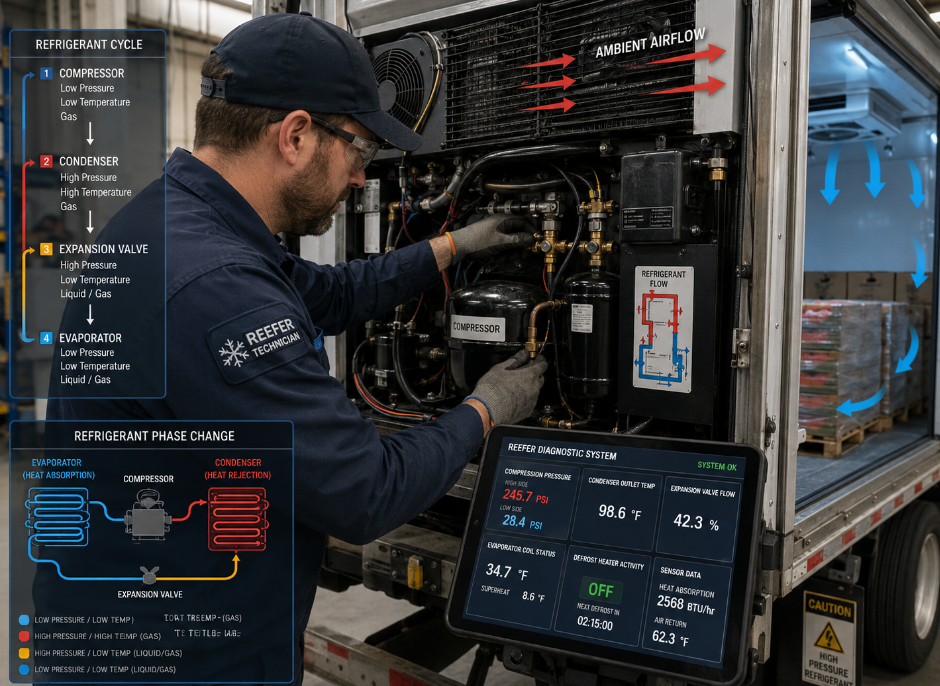
Condensation Stage in the Condenser Coils
Once superheated vapor exits the compressor, it enters the condenser coils.
Heat Management
Phase Outcome
Vapor → liquid
Pressure remains high
Fan pushes ambient air across coils
Active heat exchange begins
Controlled heat rejection lowers temperature
| Stage | Refrigerant State | Pressure Level | Temperature Range |
|---|---|---|---|
| Inlet | Vapor | High | 70–90°C |
| Mid | Condensing Mix | High | 40–60°C |
| Exit | Liquid | High | 30–45°C |
This liquid refrigerant is now ready for the next move in the reefer truck system.
Expansion Valve – Regulating Pressure and Flow
The expansion valve acts like a gatekeeper.
Control Mechanism
Immediate Impact
Precise pressure regulation
Metered flow control
Sudden throttling effect
Drops to low pressure
Creates low temperature
Produces cold liquid refrigerant
In a working reefer trailer, this quick pressure drop is what makes rapid cooling possible. No drama, just physics doing its job.
Evaporator Action and Defrost Heater Function
Inside the cargo area of a reefer truck, the evaporator handles the real cooling.
Cooling Cycle
Air Circulation
Fans push cold air
Air moves through cargo space
Return airflow completes loop
Cold refrigerant enters at low pressure
Absorbs heat through heat absorption
Undergoes phase change back to vapor
Frost Control
Ice buildup forms as frost
Defrost heater activates
Coils stay efficient
A well-tuned reefer truck keeps airflow steady and coils clean. That’s exactly the design focus behind Reefertruckpro systems—steady cooling, fewer surprises, and cargo that arrives fresh without the stress.
5 Temperature Zones In Fridge Trucks
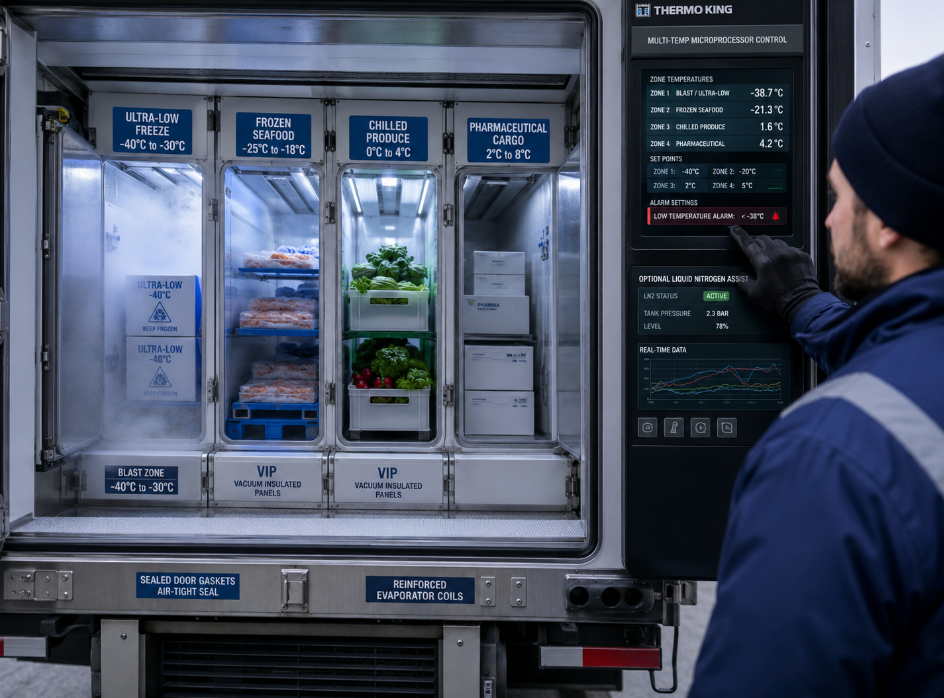
Modern cold chain logistics relies on the right reefer truck setup. From ultra-low blast freezing to gentle fresh produce cooling, each reefer truck zone plays its own role in safe food and pharma transport.
Blast Zone (−40°C to −30°C) with Vacuum Insulated Panels
In a high-performance reefer truck, the blast compartment handles ultra-low temperature demand with serious muscle.
Core Cooling Architecture
Liquid nitrogen assist (optional)
Rapid pull-down cycles
High-output compressor
Reinforced evaporator coils
Blast freezing system
Cryogenic refrigeration compatibility
Insulation Strategy
Locks in extreme cold
Protects specialized cargo
Reduced thermal bridging
Maximum thermal efficiency
Vacuum insulated panels
Sealed door gaskets
Operational Control
Digital microprocessor
Real-time data display
Alarm triggers below −38°C
This zone is built for seafood exports and pharma payloads that can’t risk temperature drift inside the reefer truck body.
Compressor Vs. Absorption Systems
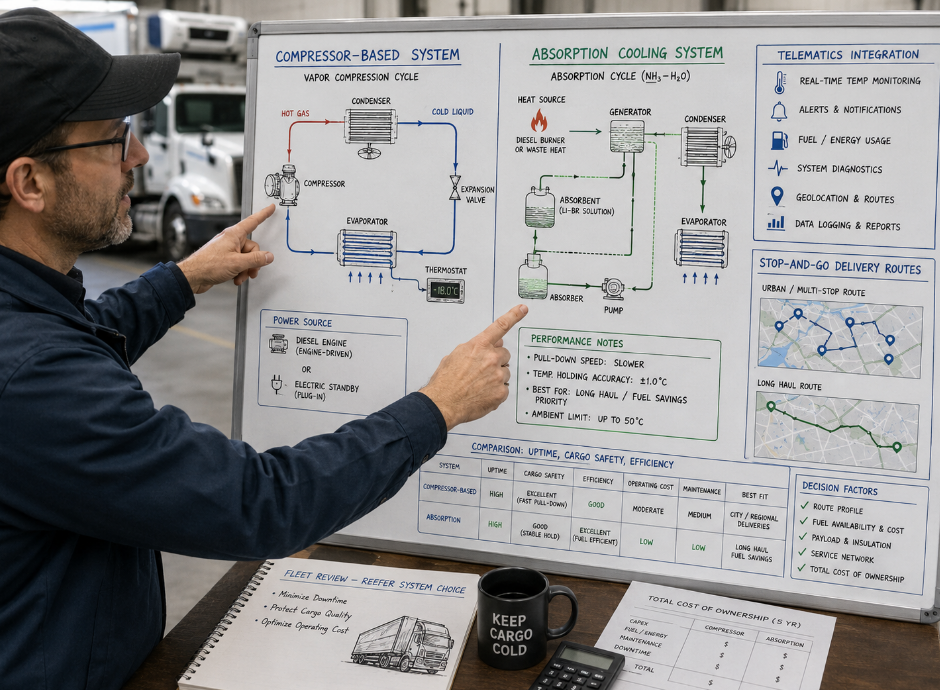
Choosing the right cooling setup for a reefer truck isn’t just tech talk—it’s money, cargo safety, and uptime on the road. In the world of refrigerated transport, the battle between compressor and absorption systems shapes how every reefer, truck reefer unit, and refrigerated truck performs. Let’s break it down in plain terms.
Compressor System
In most modern reefer truck fleets, the compressor design dominates. It runs on mechanical force and keeps temps tight.
Core Working Loop
1.1 Compression Phase
1.2 Heat Release
1.3 Cooling Phase
1.4 Control
A Thermostat monitors box temperature and cycles the system.
Liquid refrigerant passes the Expansion valve, drops in pressure, then enters the Evaporator.
High-pressure vapor flows to the Condenser, dumping heat outside the truck body.
The Compressor pressurizes the Refrigerant using a diesel or electric Power source.
Why fleets prefer it
Fast pull-down for loaded reefer trucks
Accurate temperature holding for pharma or fresh meat
Easy telematics tie-in
The U.S. Energy Information Administration noted in its 2024 transportation outlook that electrified standby refrigeration is gaining traction as fleets aim to cut fuel use while maintaining cold-chain reliability.
Brands like Reefertruckpro build compressor-based units that keep a refrigerated truck steady even in stop-and-go city runs.
Absorption System
Absorption cooling shows up less often in heavy-duty reefer truck applications, yet the science is solid.
Energy Source Structure
1.1 A Heat source replaces mechanical compression.
1.2 Inside the Generator, heat separates Refrigerant from Absorbent.
Circulation Path
The vapor moves to the Condenser.
Liquid refrigerant expands and cools in the Evaporator.
The Absorber recombines vapor and absorbent.
A small Pump keeps fluid moving.
Practical Limits
Slower cooling response
Lower efficiency in large truck reefer units
Better suited for niche or stationary cooling
For most reefer truck operators hauling food daily, compressor systems still rule the road. Reefertruckpro aligns its solutions with that real-world demand, keeping every refrigerated truck ready to roll.
Energy-Saving Tips For Reefer Trucks
Running a reefer truck today isn’t cheap. Between rising fuel prices and tighter emission rules, every mile matters. A smart setup can turn your reefer truck, refrigerated truck, or cold chain truck into a lean, cost-saving machine without cutting cooling performance.
Optimize Fuel Efficiency with Shore Power Connection
For any reefer truck, plugging into shore power during loading keeps the engine off and the refrigeration unit running on electricity from the grid.
Core Impact on Fuel Efficiency
Reduced diesel burn
Lower idle wear on the engine
Stable cooling from external connection
Operational Breakdown
Park reefer truck at dock
Secure shore power connection
Switch refrigeration to external electricity
The International Energy Agency noted in its 2025 transport update that electrification at loading docks can cut auxiliary diesel consumption in cold-chain vehicles by up to 20%.
At Reefertruckpro, fleets adopting shore-powered reefer truck systems report noticeable drops in fuel logs within weeks.
Enhance Insulation: Increase Wall Thickness and K-Value
Stronger insulation changes the game for every reefer truck.
Thermal Structure Upgrade
Increase wall thickness
Lower K-value
Improve thermal barrier
| Material Type | Wall Thickness (mm) | K-value (W/m·K) |
|---|---|---|
| Standard PU | 60 | 0.024 |
| Reinforced PU | 80 | 0.021 |
| High-Density | 100 | 0.018 |
Lower K-value equals stronger temperature control and reduced compressor load. That means less fuel burned per reefer truck route. Reefertruckpro recommends pairing higher R-value panels with sealed door frames for full thermal protection.
Pre-Trip Diagnostics for Reduced Idle Time
A reefer truck that passes solid diagnostics wastes less idle time.
Inspection Focus
Pre-trip refrigerant pressure check
Fan and sensor system check
Engine performance review
Run electronic inspection
Confirm no refrigerant leaks
Clear fault codes before departure
Catching issues early reduces roadside stops and unnecessary reefer truck idling. Less idle time equals lower fuel burn and smoother cold delivery cycles.
Telematics System for Real-Time Fuel Monitoring
Modern reefer truck fleets run on telematics and real-time fuel monitoring.
Data Visibility
Live GPS tracking
Route-based consumption data
Driver behavior analytics
Management Flow
Track speed patterns
Monitor engine load
Collect telematics data
Analyze trends
Adjust routing for smarter management
Reefertruckpro integrates smart tracking tools that turn raw tracking numbers into daily savings. A connected reefer truck isn’t just cold—it’s efficient, controlled, and easier on your bottom line.
FAQ
What keeps a reefer truck cooling system stable on long hauls?
A reefer truck depends on coordination between power, refrigeration, and insulation:
1) Power drive
Diesel engine or generator set during transit
Shore power connection or electric standby at loading bays for better fuel efficiency
2) Refrigeration cycle
Compressor pressurizes refrigerant
Condenser releases heat
Expansion valve regulates flow
Evaporator absorbs cargo heat through controlled fans and refrigerant lines
3) Thermal protection
Polyurethane foam or vacuum insulated panels
Optimized wall thickness and low K-value
FRP panels with aluminum lining to limit heat gain
When these elements move in sync, temperature stays steady even across extreme climates.
How does the compressor actually function inside a reefer truck?
The compressor is the heartbeat of the refrigeration unit.
It draws low-pressure refrigerant from the evaporator, compresses it into high-pressure gas, and sends it through the condenser. After cooling and expansion, the refrigerant returns to absorb heat again.
Set point accuracy is maintained by a microprocessor controller, which adjusts compressor cycles based on signals from the temperature logger and humidity sensor. If readings drift, the system reacts instantly—protecting sensitive cargo without manual intervention.
Why is insulation quality critical when buying a reefer truck?
Insulation defines cargo survival time during traffic delays or power shifts. Key specifications include:
Materials:
Closed-cell polyurethane foam
Extruded polystyrene
Vacuum insulated panels for premium builds
Performance indicators:
Controlled wall thickness
Low K-value for minimal thermal transfer
Integrated thermal barriers
Combined with composite walls, stainless steel floor, and galvanized subframe, strong insulation reduces compressor workload and improves fuel efficiency over years of service.
How does multi-zone temperature management protect mixed cargo?
A single trailer can carry chilled produce and frozen goods—if designed correctly.
Multi-zone capability divides the cargo space using partitions and controlled air chutes. Each zone has:
Independent set points
Dedicated fans and airflow routing
Monitoring through remote monitoring and data logging systems
With API connectivity and telematics system integration, fleet managers track every compartment in real time. A minor fluctuation in one zone no longer risks the entire load.
What design features improve durability and daily operation of a reefer truck?
| Category | Key Elements | Operational Benefit |
|---|---|---|
| Trailer Body Construction | FRP panels, riveted construction, high-strength steel | Resists corrosion and road vibration |
| Cargo Area Features | Load securement tracks, forklift reinforcement, floor drains | Faster loading, easier cleaning |
| Chassis and Drivetrain | Optimized axle configuration, suspension type, braking system | Stable handling at full payload capacity |
| Fleet Integration & Telematics | GPS tracking, remote diagnostics, fuel efficiency monitoring | Lower downtime, smarter dispatching |
Behind every reliable reefer truck stands thoughtful engineering—from expansion valve to wheelbase length—working quietly to protect valuable cargo mile after mile.